Introduction: When Dialogue Becomes Personal
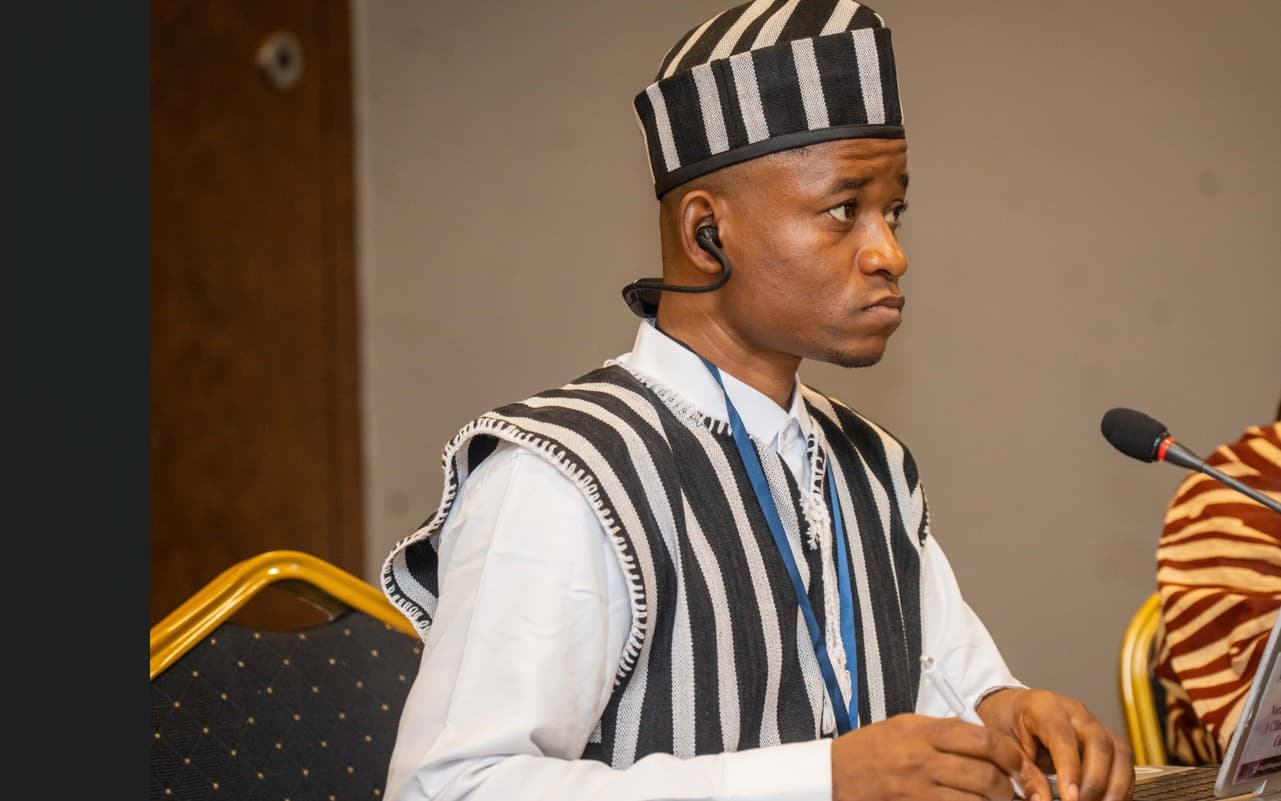
There are moments in one’s professional journey when participation in a conference transcends routine engagement and becomes something far more introspective. Attending the EU Climate Security Dialogue in Abidjan was one of those moments for me.
On the surface, it was a high-level regional convening held from 25–27 March 2026, bringing together policymakers, practitioners, civil society actors, and researchers to examine the intersections of climate change, peace, and security in West Africa. Yet beneath the formal structure of panels, presentations, and working groups, the dialogue unfolded as something more profound, a space where global policy conversations intersected with deeply personal realities.
As someone whose work sits at the intersection of peacebuilding, youth engagement, and policy advocacy, I arrived in Abidjan expecting to engage with ideas, frameworks, and partnerships. What I did not fully anticipate was how deeply those conversations would resonate with my own lived experiences, particularly my connection to Benue State, a region that has increasingly become a frontline of climate-related conflict in Nigeria.
By the end of the dialogue, it became clear that this was not just about understanding climate security as a concept. It was about confronting its human dimensions, its contradictions, and its implications for both my work and my identity.
Climate Change as a Security Reality
One of the most striking realizations throughout the dialogue was how firmly climate change has transitioned from being an environmental concern into a defining security issue in West Africa. Discussions consistently pointed to the growing intensity and unpredictability of climate patterns across the region: rising temperatures, erratic rainfall, prolonged droughts, flooding, and land degradation. These changes are not occurring in isolation. They are interacting with pre-existing socio-economic and political vulnerabilities, creating layered and compounding risks.
In many parts of the region, agriculture and pastoralism, the backbone of rural livelihoods, are becoming increasingly difficult to sustain. Cropping seasons are less predictable. Water sources are drying up or becoming contested. Grazing routes that once followed established patterns are shifting in response to ecological stress. As livelihoods become more precarious, tensions over access to land and water intensify.
Yet what stood out most was the insistence, repeated across sessions, that climate change does not directly cause conflict. Rather, it acts as a “threat multiplier”, amplifying existing grievances, inequalities, and governance failures. This distinction is critical. It forces a move away from overly simplistic narratives that attribute conflict solely to environmental change, and instead encourages a more nuanced understanding of how climate interacts with governance, identity, economics, and power. In essence, climate change is not rewriting the script of conflict; it is accelerating and intensifying the dynamics that were already present.
The Complexity of Farmer–Herder Conflicts: A Lesson in Context
Among the many moments that shaped my experience in Abidjan, one stands out as particularly transformative. During discussions on the Liptako-Gourma region, a participant from that context offered a perspective that challenged a deeply ingrained assumption. In his account, it was the herders, not the farmers, who were often the most vulnerable group, bearing the brunt of farmer-herder conflict, insecurity, and livelihood disruption.
I found myself pausing. This perspective stood in stark contrast to my own experiences in Nigeria, particularly in Benue State, where the dominant narrative often positions farming communities as the primary victims of farmer-herder conflicts. In that moment, something shifted. It became clear that what we often refer to as “farmer-herder conflict” is not a uniform phenomenon. It is not a single story with fixed roles of victim and perpetrator. Instead, it is a complex, context-dependent reality shaped by local histories, ecological conditions, governance structures, and socio-political dynamics.
In some contexts, herders are seen as aggressors; in others, they are themselves adversely affected, marginalized, and vulnerable. Their motivations, movements, and interactions with farming communities vary significantly across regions and locations. This realization deposited something important in my consciousness: context is everything. It is not enough to understand conflict at a regional or national level. Meaningful engagement requires a willingness to interrogate assumptions, to listen to diverse perspectives, and to appreciate the fluidity of roles within conflict systems. For me, this was not just an analytical insight, it was a personal recalibration. It challenged me to approach my work with greater humility and a deeper commitment to context-sensitive analysis.
From Policy to Practice: Bridging the Implementation Gap
As the dialogue progressed, another recurring theme began to emerge with increasing clarity: the persistent gap between policy ambition and practical implementation. Across West Africa, there is no shortage of frameworks addressing climate change and its security implications. Governments have developed National Adaptation Plans, updated their Nationally Determined Contributions, and, in some cases, begun formulating dedicated climate-security strategies. On paper, the region is rich with policy commitments. Yet the reality on the ground tells a different story.
Participants repeatedly highlighted the fragmentation of efforts across sectors and institutions. Ministries responsible for environment, security, agriculture, and development often operate in silos, with limited coordination. Policies designed at the national or regional level frequently fail to resonate with local realities. Funding remains insufficient and heavily dependent on external partners. The result is a disconnect between vision and action.
What became increasingly evident is that the true test of any climate-security framework lies not in its design, but in its ability to translate into tangible outcomes at the community level. Implementation is where ambition meets reality, and where many well-intentioned strategies falter.
A Different Kind of Policy Conversation
One of the more unexpected aspects of the Abidjan Dialogue was the tone adopted by government representatives. In many international and regional conferences, it is common for government officials to emphasize achievements, defend policies, and project a carefully curated image of progress. However, this dialogue felt different. There was a noticeable openness, an unusual willingness among government participants to engage in self-reflection and critique.
They spoke candidly about the limitations of existing frameworks, the challenges of coordination, the gaps in funding, and the difficulties of translating policy into action. Rather than presenting polished narratives, they acknowledged complexity and imperfection. This level of honesty transformed the quality of the discussions. It created space for genuine dialogue rather than performative engagement. It allowed participants to move beyond identifying problems to collectively exploring solutions.
For me, this was both refreshing and instructive. It demonstrated that progress in addressing complex challenges like climate security requires not only technical expertise, but also a culture of openness, humility, and continuous learning within governance systems.
The Human Face of Climate Security: Reflections from Benue
Throughout the dialogue, I found myself repeatedly returning to my own community in Benue State. The discussions about climate variability, livelihood disruption, and resource-based conflict were not abstract; they mirrored realities that have unfolded in my own environment.
In Benue, changing rainfall patterns have altered farming cycles, reducing productivity and increasing uncertainty. At the same time, shifting ecological conditions have influenced pastoral movements, bringing herders and farmers into closer and more frequent contact. These dynamics have contributed to cycles of violence that have displaced communities, eroded trust, and disrupted social cohesion. Listening to participants describe similar patterns across the region, I was struck by how local experiences are embedded within broader regional and global trends.
It reinforced a powerful realization that climate security is not a distant policy concern; it is a lived reality for millions of people. This understanding deepened my sense of responsibility as a peacebuilding practitioner. Addressing conflict today requires engaging not only with social and political factors, but also with environmental drivers that are reshaping the context in which communities exist.
Communities as Agents of Resilience
Amid the challenges discussed, the dialogue also highlighted an important source of hope: the resilience and agency of communities. Rather than portraying communities solely as victims of climate change, participants emphasized their role as active agents of adaptation and peacebuilding. Youth and women, in particular, were identified as both disproportionately affected by climate risks and uniquely positioned to drive innovative solutions. Civil society organizations were recognized for their critical role in mediation, early warning systems, and community engagement.
These insights resonate strongly with my work at Building Blocks for Peace Foundation and the Global Partnership for the Prevention of Armed Conflict (GPPAC) - West Africa, where community-driven approaches are central. The lesson here is clear: sustainable solutions must be built on local knowledge, participation, and ownership.
Beyond Borders: The Need for Regional Cooperation
Another key takeaway from the dialogue was the inherently trans-boundary nature of climate-security risks. From transhumance routes to migration patterns, from shared water resources to cross-border ecosystems, the challenges facing West Africa cannot be contained within national boundaries. Attempts to address these issues through isolated national responses often prove inadequate.
At the same time, the dialogue highlighted promising examples of cooperation, shared resource management initiatives, cross-border agreements, and innovative approaches like linking peace agreements to livelihood opportunities. These examples demonstrate that even in a region marked by political tensions, there are opportunities for collaboration.
Financing Climate Security: The Missing Piece
Despite the wealth of ideas and frameworks discussed, one issue remained a persistent constraint: funding. The absence of dedicated financing mechanisms for climate-security initiatives continues to limit the scale and sustainability of interventions. National strategies often rely heavily on external support, while private sector engagement remains limited. This creates a situation where ambition outpaces capacity. Addressing this gap will require not only increased funding, but also more innovative and coordinated approaches to financing.
From Reflection to Action
As the dialogue came to a close, the question that remained was not what had been discussed, but what would be done next. For me, the experience has reinforced the need to: Integrate climate considerations into peacebuilding work, strengthen early warning systems, support community-led initiatives, and advocate for context-specific solutions.
Conclusion: Seeing Climate Security Differently
The journey from Abidjan back to Nigeria was as much reflective as it was physical. The dialogue challenged assumptions, deepened understanding, and reinforced the importance of connecting global conversations to local realities. Ultimately, it reaffirmed a simple but powerful truth that sustainable peace cannot be separated from the environmental realities that shape human existence.
Special thanks to the Global Partnership for the Prevention of Armed Conflict (GPPAC) for making my participation in this conference possible through the CLIMPSE (Climate, Peace and Security) project.
Written by
Samson Shabu,
Programme Officer,
Climate, Peace and Security